June 2026
MoTuWeThFrSaSu
最近のダイアリー2026-06-26-網頁搭建先前也嘗試過搭個人網頁,只不過受限於審美經驗和開發方面的技術,做出來總覺得千篇一律,不能展現「個人」…
Optics
Textbook: Max Born, Principles of optics: Electromagnetic theory of propagation, interference and diffraction of light
Optics(Max Born, CUP, 1999)
Ch1 Basic Properties of the Electromagnetic Field
- The electromagnetic field.
- The wave equation and the velocity of light:
- When and the medium is homogeneous, we have . The “velocity” can be determined as by comparing .
- Note this holds only for plane waves. Thus should better be conceived as a “characteristic velocity of propagation”.
- The law of refraction: (refractive index). An absolute refractive index then satisfies .
- Equivalent to that the wave-front is continuous, or the intersection of the incident and refracted wave moves at a same speed on both sides of the boundary, .
- Maxwell’s formula: . In fact is close to unity for most of nonmagnetic substances.
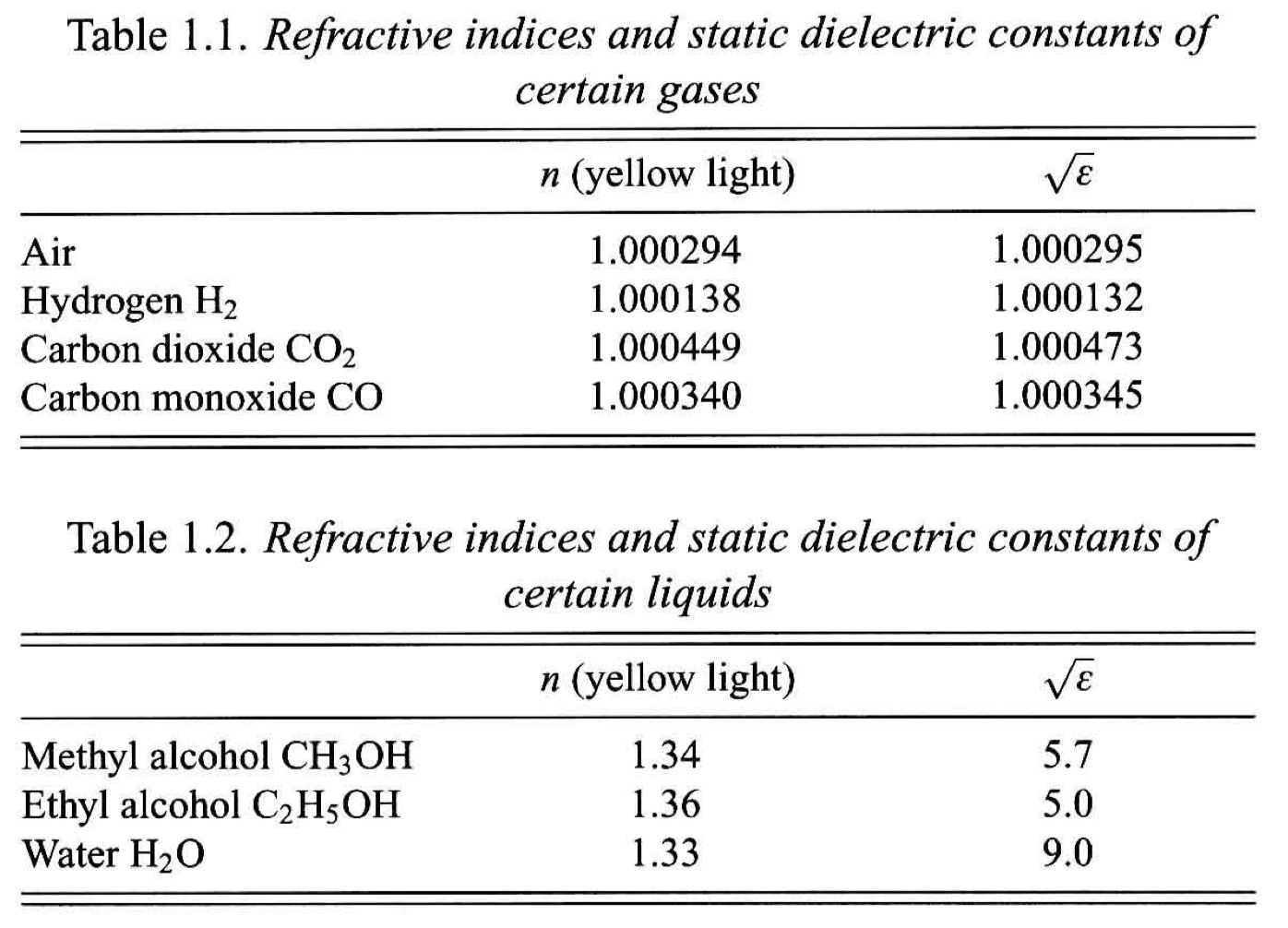
- When and the medium is homogeneous, we have . The “velocity” can be determined as by comparing .
- Scalar waves: Solving .
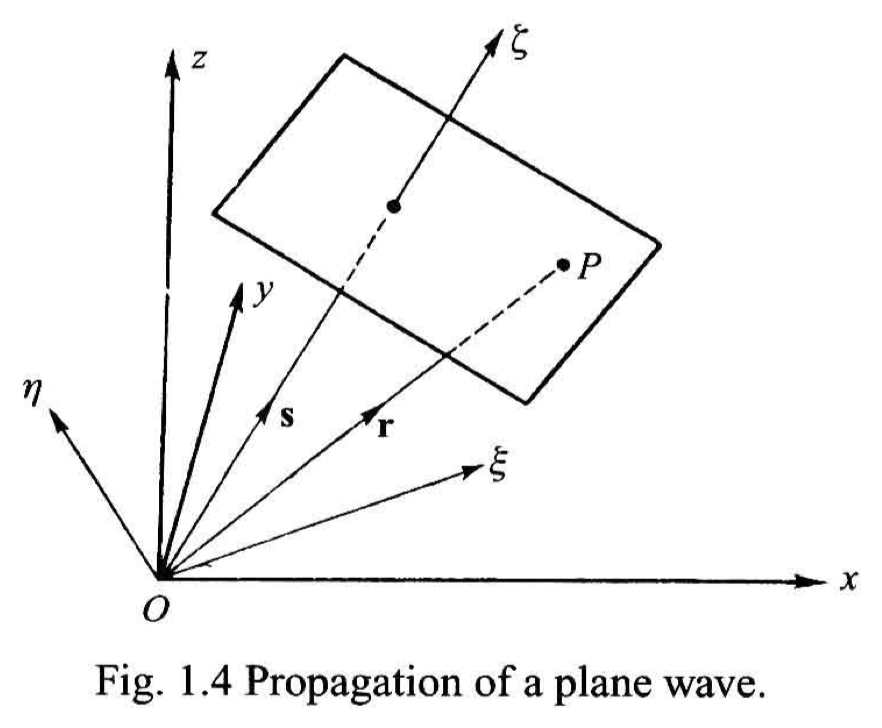
- Plane waves: where is a position vector and is a unit vector in a fixed direction. The term “plane wave” is due to that holds constant over planes which are perpendicular to . We may take and find , simplifying the equation to . The general solution is . holds constant for . Therefore it represents a disturbance propagated with in the direction. Likewise -> direction.